27 May 2026

VikingRed — healthy cows, stronger profits

Strong health and fertility, efficient feed use, and high milk solids are shaping the next generation of profitable dairy herds. With medium-sized, energy-efficient cows and proven genetic progress, VikingRed delivers a strong bottom line while supporting future climate and animal welfare goals.

As dairy production continues to evolve, farmers are increasingly looking for cows that combine performance with resilience and adaptability. For nearly half a century, the VikingRed breeding programme has maintained a clear and consistent breeding goal: developing a balanced red dairy cow. This long-term commitment has created functional cows that perform reliably under modern production environments.

Securing profitability while tackling rising costs, climate challenges, and increasing demands for animal welfare is changing the priorities of dairy producers. VikingRed meets these challenges and is proving its value as a red dairy breeding program built for the future.

The VikingRed breeding program brings together three strong dairy breeds: Swedish Red, Finnish Ayrshire, and Danish Red. This unique combination delivers high genetic gain across all economically important traits. The result of close breeding collaboration in the Nordic countries is a robust and efficient red cow. VikingRed cattle offer a distinctive mix of characteristics, making them exceptionally well-suited for future dairy production with high profitability, where low climate impact and high animal welfare are key priorities.

Backed by decades of large-scale data from commercial herds, VikingRed offers world-leading genetics for red dairy cattle. The breed is recognised for strong health and fertility, moderate size, excellent efficiency, and high solids production — traits that together support profitability and high animal welfare.

To explore the key strengths behind VikingRed and understand how the breed supports long-term performance in modern dairy systems, we interviewed two VikingRed breeding experts, Camilla Rosman, Product Manager for VikingRed, and Morten Kargo, Breeding Manager for VikingRed at VikingGenetics, to gain insights into the latest breeding results supported by reliable on-herd data from the Nordic countries.


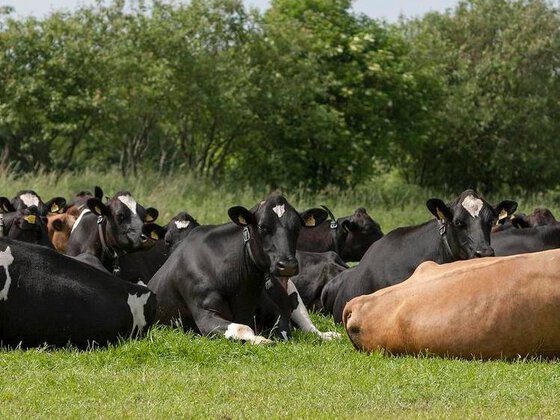
VikingRed cows grazing

Same bottom line — differently composed

Profitability in dairy farming is not only about maximising milk yield. It is about balancing production with costs and efficiency. VikingRed delivers a strong bottom line driven by excellent health and fertility, low cow mortality, medium-sized cows, and milk with high components.

VikingRed cows combine competitive production with lower overall costs compared with other dairy breeds. Reduced expenses for feed, veterinary treatments, labour, and herd replacement all contribute to stable and predictable returns. Their natural robustness creates the basis for a long productive life, increased lifetime yield and improved income from both milk and beef. 

Data from Denmark (RYK, 2025) show that red cows have a 34% higher carcass classification than Holsteins: RDC – 3.73, Holstein – 2.79. Meanwhile, slaughter weights are nearly the same, at 323 kg for RDC and 330 kg for Holstein.

“VikingRed cows are profitable because they are balanced,” said Camilla. “They deliver the same strong bottom line as Holstein — just composed differently, through better health, better fertility and efficiency rather than pushing production alone.”

With moderate cow size and high energy efficiency, VikingRed cows convert feed into milk and solids effectively while maintaining strong body condition. This balance reduces metabolic stress and supports better performance across multiple lactations, rather than peaking early and leaving the herd prematurely.

With an average stature of 143 cm in Sweden, Finland, and Denmark, VikingRed cows are moderate in size — delivering clear practical and environmental benefits. Their balanced frame allows them to perform efficiently in existing barns, reducing the need for costly upgrades or new construction. Since building new facilities carries a significant climate footprint, the ability to utilise current infrastructure supports more sustainable herd development while maintaining productivity and functionality.

VikingRed cow

Robust, fertile and alert cows last longer

Longevity is one of the most powerful profit drivers in dairy farming. Each additional productive lactation reduces replacement costs and spreads rearing expenses over more productive years. VikingRed cows are widely recognised for their disease resistance, a “willingness to live” and ability to recover quickly — traits that support long herd life and low veterinary costs.

Built on decades of systematic recording in Nordic production herds, VikingRed genetics prioritize functional traits such as udder health, hoof health, fertility, and calving ease. The result is resilient, alert cows that look after themselves, maintain strong performance, and require minimal attention.

“Strong health, fertility and resilience are key reasons why VikingRed cows stay productive,” explained Camilla. “These cows are built to cope with everyday challenges and keep going. They are easy to manage, also for not experienced employees.”

Lower cow mortality

VikingRed’s lower cow mortality and reduced disease incidence compared with other breeds highlight the breed’s robustness, supporting longer productive lifetimes, lower veterinary costs, and better overall animal welfare.  According to recent data from Denmark (RYK, 2025), VikingRed has 33% lower cow mortality and 20% lower disease incidence compared with other dairy breeds. With an average cow mortality of 3.4% and just 0.6 disease cases per cow per year across Danish herds, this resilience reduces veterinary costs, supporting higher lifetime productivity and stronger profitability for farmers.

Strong hoof health

VikingRed cows are known for strong feet and legs and excellent hoof health. Data recorded by professional hoof trimmers show that Red cows have a lower incidence of the two most common hoof disorders — digital dermatitis (43% less across Denmark, Sweden and Finland) and sole haemorrhage (19% less) — supporting better mobility, durability, and long-term performance.

Excellent fertility and calving ease

Reproductive efficiency plays a decisive role in overall herd performance. VikingRed offers naturally strong daughter fertility, supporting efficient reproduction with fewer inseminations, shorter calving intervals, and reduced labour requirements. With conception rates of 63% in heifers and 53% in cows, VikingRed genetics help maintain stable reproduction across lactations. Calf survival rates reach 96% in first lactation and 97% in second and later lactations, ensuring healthy calves and few losses.

Good fertility and calving ease reduce stress on both cows and farmers. Fewer problem calvings, stronger calves, and reliable conception; all contribute to lower veterinary and insemination costs and improved animal welfare. “Fertility is fundamental to profitable dairy production,” said Camilla. “When fertility works, everything else becomes easier — from labour planning to herd replacement.”

The unique blend of desirable traits makes VikingRed suitable for a wide range of environments — from intensive indoor systems to pasture-based production. They are also an excellent choice for organic production. Across systems, they deliver steady milk production and strong functional traits.

VikingRed cows in the barn
VikingReds stand out for their strong health, reproduction and resilience, making them a breed built for the future. VikingRed brings world-leading genetics for red dairy cattle — backed by decades of data from production herds. I truly believe we have the best red cows in the world.

Camilla Rosman,
Product Manager for VikingRed

Feed conversion efficiency: strong growth and milk production on lower concentrate

Feed is the single largest cost in milk production, and feed efficiency is increasingly critical for both profitability and climate impact. VikingRed cows grow and produce effectively on lower-concentrate diets, excelling on roughage and pasture while maintaining strong milk and solids output. 

This adaptability is supported by research from the Danish Cattle Research Center, which compared Holstein, VikingRed, and crossbred heifers under Danish conditions to assess weight, growth, feed intake, and efficiency. 

“Holstein heifers showed reduced growth on a low-energy feed compared with a standard feed. In contrast, VikingRed heifers maintained consistent growth regardless of feed energy, demonstrating greater adaptability to different rations,” highlighted Morten.

“The VikingRed’s capability to grow on less energy is very valuable in grazing systems where the amount of feed from the grass can vary between seasons. VikingRed and crosses are therefore very suitable for grazing production systems,” he added.

Furthermore, the study also showed that when the Red Dairy Cattle (RDC) animals that were fed low-energy feed as heifers started their second lactation, they produced significantly more milk compared to RDC heifers fed the standard feed recommendation.

“This study shows clearly that you can feed RDC heifers a cheaper feed with lower energy, and at the same time increase production. It’s a win-win,” Morten explains.

Read more about the study
VikingRed heifers

Lower feed costs with VikingRed

With moderate size and high energy efficiency, VikingRed cows convert feed into milk and solids effectively. Data from a Danish mixed herd owned by Torben Due, Østerviggård, illustrate this efficiency, showing that VikingRed cows achieve similar production to Holsteins while consuming less feed. Data shows that red cows have a 10% lower dry matter intake than Holsteins (22.09 kg for red cows vs. 24.5 kg per day for Holstein cows), without compromising performance. With feed priced at €0.20 / A$ 0.33 per kg DM, this reduced intake translates into significant annual savings — roughly €176 / A$287.15 per cow, or around €35,000 / A$57,430 for a 200-cow herd. By consuming less feed while maintaining productivity, VikingRed cows deliver improved margins and a more resource-efficient production system.

“It is important to note that VikingRed cows require feed rations tailored to their breed — typically higher in roughage and lower in energy than those for Holsteins — to maximise efficiency and performance,” explained Morten.

VikingRed’s strength in energy efficiency is supported by data from VikingGenetics’ Cattle Feed Intake System (CFIT), which captures live, daily data on individual cows’ feed intake across full lactations, entire lifetimes, and whole herds. The system collects data from cows that are genetically close to today’s reference animals, enabling highly relevant and reliable breeding decisions.

Using this large-scale data, VikingRed sires deliver measurable efficiency gains. In a 200-head herd, improved feed efficiency (effect of 10 index units for the Saved feed index) can result in savings of up to 40,000 kg of dry matter intake (€8,000 / A$13,052) per year — without compromising milk yield, health, or fertility. These savings directly reduce feed costs and lower methane emissions per kilo of milk produced.

Their efficiency in saved feed and the Nordic commitment to lowering methane emissions strengthen their value even further. When cows convert feed better, it benefits both the farmer and the climate”, said Camilla. 

Discover the Saved Feed index

A natural choice for the next generation of dairy farmers

Large genetic variation within the VikingRed population allows for continuous genetic progress while maintaining robustness and adaptability. The breeding program delivers consistent genetic gains in production, health, fertility, and efficiency — proven under real production conditions rather than experimental settings.

“VikingRed brings world-leading genetics for red dairy cattle — backed by decades of data from production herds. This is what secures reliable progress in commercial farming,” said Camilla. “I truly believe we have the best red cows in the world. The red breed is heading toward an exciting future.”

VikingRed sires with superior genetic traits are contributing to notable improvements in herd performance. These advances lead to better milk production, enhanced health traits, and overall greater efficiency, all of which help boost profitability.

In recent years, there has been significant genetic progress within VikingRed, driven by the use of high-performance bulls like VR Vesty (4.4 SD above average) and VR Vimo (1.9 SD above breed average) – May 2026 proofs.

Take a look at the genetic progress for NTM and key traits for VikingRed bulls across Denmark, Finland, and Sweden from 2015 to 2025. Click “+” to view the figures.

Table 1: Genetic progress for NTM and the key traits for VikingRed bulls in Denmark, Finland and Sweden 2015-2025

   2015 2025 2015-2025
 NTM  -6  29  +35
 Yield  97  119  +22
 Saved feed  99  100  +1
 Daughter 
 fertility
 99  108  +9
 Calving
 direct
 100  103  +3
 Calving
 maternal
 99  105  +6
 Longevity  97   108  +11
 Udder health  99  106  +7
 Hoof health  97   107  +9
 General
 health
 101  106  +5
 Youngstock
 survival
 96  104  +8
 Udder  96  108  +12
 Feet & Legs  101  107  +6
 Milkability  98  105  +7
 Temperament  99  103  +4
VR Vesty daughter

Consistent breeding progress for increased profit

By selecting VikingRed bulls with a high NTM, you can make significant improvements in your herd’s productivity. This genetic progress directly translates into better performance, leading to increased returns and a stronger bottom line for your operation. Over time, these improvements will benefit your farm, enhancing both efficiency and profitability in the long run.

Through data-driven genetic progress in the key traits that matter most, VikingRed proves that cows can deliver high performance without compromising resilience and welfare — helping farmers keep costs down and protect their bottom line. “My vision is that VikingRed will become the natural choice for the next generation of dairy farmers,” said Camilla.

Medium-sized, energy-efficient and adaptable, VikingRed cows are designed for the future of dairy farming. They deliver strong production with lower inputs, high animal welfare, and reduced climate impact, making them a natural choice for farmers focused on long-term sustainability and profitability. With a balanced bottom line, VikingRed also meets consumer demands by producing high-quality milk efficiently and supporting responsible farming practices.

Find the best VikingRed bulls
VikingRed cow

VikingRed - the magical ingredient in crossbreeding

VikingRed is the key ingredient in successful crossbreeding, delivering adaptable cows that thrive across a wide range of production conditions. These cows are built for long-lasting productivity while helping reduce overall costs — from feed and veterinary care to labour and herd replacement.

Naturally resilient, VikingRed crossbreds require minimal antibiotic use and are known for their strong health and robustness. They combine reliable fertility, excellent survivability, and high value for both meat and milk production. By improving health, fertility, and efficiency, VikingRed adds lasting profitability to any crossbreeding program.

Dairy crossbreeding offers a practical way to address these challenges. When two unrelated breeds are crossed, the offspring benefit from heterosis, or hybrid vigour. Heterosis effect is strongest for traits such as fertility, health, vitality and survival.

Heterosis also helps counteract the negative effects of inbreeding. Crossbreeding also allows farmers to combine the strengths of different breeds. When selected carefully, these breeds complement one another, resulting in cows that are easier to manage and better suited to the production system.

The real strength of modern dairy crossbreeding lies in structured, system-matched approaches. Across many countries and production systems, well-designed crossbreeding programs have been associated with profitability improvements of around 5–15%, driven by better health, lower replacement rates and higher lifetime production per cow.

When crossbreeding is approached in a structured and consistent way — using unrelated, high-quality breeds, selecting top bulls from each, and following a defined strategy — it becomes a reliable tool rather than an experiment.

Across diverse dairy systems worldwide, our crossbreeding results in improved fertility, longevity and lifetime profitability have been independently validated, delivering reliable outcomes on farm.

Table 2: Heterosis effect for the key traits

 Traits

Heterosis

Milk, fat and protein yield

1-10 %​

Fertility​

5-12%​

Calving performance and stillbirth

5-15%​

Udder health​

0-7%​

Other diseases​

5-20%​

Longevity​

5-20%​


Dairy crossbreeding is most effective when it’s matched to the system you’re running. The right breed mix increases lifetime output, lowers replacement and health costs, and reduces labour per cow, with heterosis providing an added lift beyond the parent average. The focus isn’t on one trait, but on balanced cows – fertility, health, longevity and lifetime output.

Morten Kargo,
Product Manager Dairy Cross and Breeding Manager VikingRed

System-specific crossbreeding with proven profitability

PASTURE-BASED SYSTEMS

PASTURE-BASED SYSTEMS

VikingGoldenCross, a 3-breed rotational crossbreeding program combining VikingHolstein, VikingRed, and VikingJersey, is commonly used where fertility, low maintenance and robustness are critical.

Learn more about VikingGoldenCross
CUSTOMISED SYSTEMS

CUSTOMISED SYSTEMS

VikingRed-based crosses are often used in extensive grazing systems. Many farms also adopt customised rotations, such as Red × Jersey, or incorporate locally adapted breeds to address specific challenges including heat stress, disease pressure or the need to increase milk solids.

Contact our team to learn more
Boost profits with VikingRed sires Explore our VikingRed bull line-up
VikingRed cow and farmer